Welcome to the first official preview for Vs. System 2PCG! We will be doing a few of these previews in the coming weeks. In each preview, developers Danny Mandel and Ben Cichoski will showcase different types of cards and card mechanics that you’ll want to become familiar with when Vs. System 2PCG launches. So without further adieu, let’s get started!
Hi everyone,
Today’s preview is about Characters. In the Vs. System 2PCG there are Main Characters and Supporting Characters. Each player starts with a Main Character and can recruit Supporting Characters during the game. While in play Main Characters work just like Supporting Characters – they go in your front or back row, attack and defend, use powers, get stunned, take wounds, etc. – with the following exceptions:
- If your Main Character gets KO’d, you’re out of the game.
- Your Main Character can level up to a more powerful version.
- A handful effects refer specifically to a “Main Character” or to a “Supporting Character.”
The Main Event
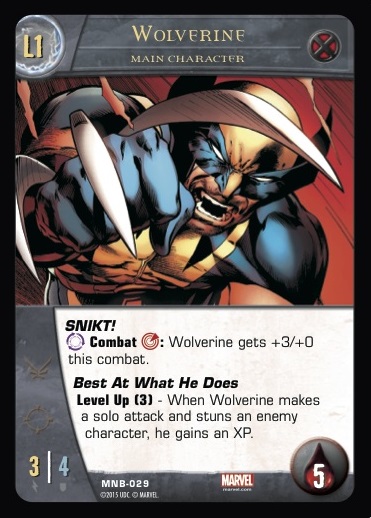
This is the Level 1 version of the Wolverine Main Character. Let’s take a quick look at the elements of his card.
Level Number: The top left of a Main Character shows what level it is. Level 1 versions have silver card frames and Level 2 versions have gold frames.
Name: Found at the top middle of the card.
Card Type: There are four card types: Main Character, Supporting Character, Plot Twist, and Location. This is underneath the Name.
Team Affiliation: Found at the top right. Each team has their own symbol. Team Affiliation is used to determine if two or more characters can attack together (called a team attack), which Plot Twists you can play, and whether Special Locations can be used with a character.
Text Box: Found underneath the card image. There are three types of powers in the game: Keywords, Super Powers, and Level Up Powers. Keywords simply have instructions to follow, Super Powers are activated, and Level Up powers determine how Main Characters gain Experience (XP).
Flight and Ranged Symbols: Found to the left of the text box. Flight and Ranged give characters more options during combat. A character can have Flight, Ranged, both, or neither. These symbols are either active or inactive depending on whether the character has Flight or Ranged.
ATK and DEF: The two numbers on the bottom left, below the Flight and Ranged symbols, are a character’s combat stats. During combat the attacker and defender compare their ATK (above the lightning bolt) to their foe’s DEF (above the shield) to see if any characters in the combat get stunned.
Health: Located at the bottom right, a character’s Health tells you how many wounds it takes to KO that character. Most Main Characters have 5-6 Health. Most Supporting Characters have 1-2 Health.
On the Level
Each Level 1 Main Character has a Super Power and a Level Up Power. We’ll cover how Super Powers work in next week’s preview, but let’s dive into Wolverine’s Level Up Power.
The “3” is how much XP Wolverine needs in order to Level Up. Each time he attacks alone and stuns an enemy, he’ll gain an XP. Take an XP counter that comes in the box and put it on his Level 2 card which starts out of play. Once he has 3 XP, he instantly levels up and you swap in his Level 2 version.
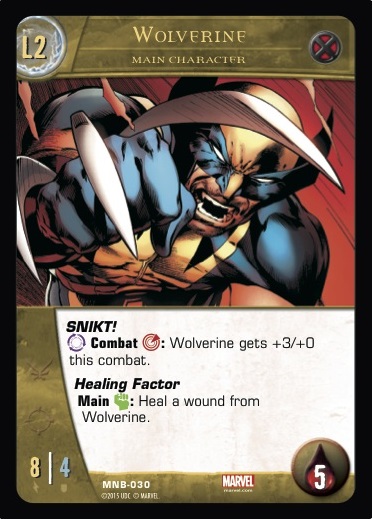
As you can see, when a Main Character levels up, it gets a stat increase and a new Super Power. (Note: Its starting Super Power remains the same.)
When you swap in the Level 2 version, it retains all other current characteristics from its Level 1 version. This includes its orientation (ready/exhausted or stunned/face-up), any +1/+1 or -1/-1 counters it has, and any other modifiers.
The game’s initial set has 16 Main Characters (4 for each team), and each one has a different Level Up power. Here’s another example:

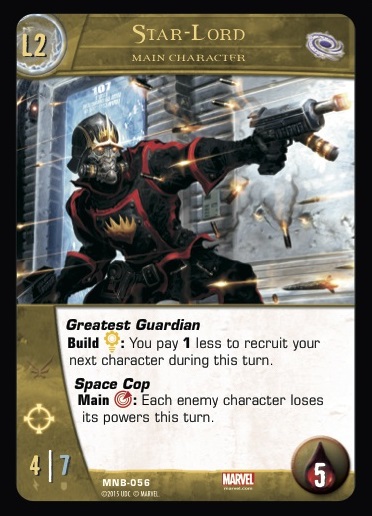
Supporting Cast
Each team also has several Supporting Characters, such as the X-Men’s Beast:
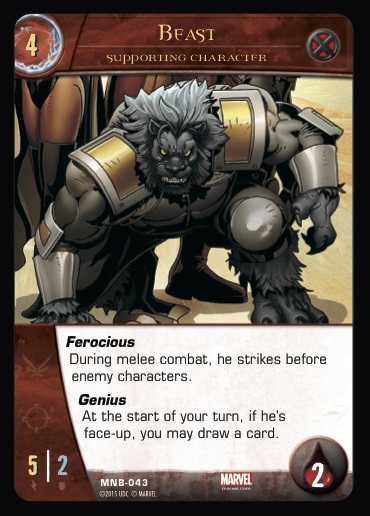
Supporting Characters have the same elements as Main Characters, except they have a cost in the top left instead of a Level Number. Supporting Characters don’t get Level Up Powers, but Beast has a couple of Keyword powers. Unlike other types of powers, Keyword powers often show up on multiple characters.
Each Main Character in the set also has a Supporting Character version.
Power Play
You can only have one character with a specific name in play at a time. However, you can discard a card with that name from your hand in order to “Power-Up” the one in play, which gives it a +1/+1 counter. For example, let’s say I attack with my Wolverine Main Character, I could discard a Wolverine Supporting Character from my hand in order to Power-Up my Main Character.
You can also discard a Supporting Character to power-up another one of your Supporting Characters with the same name.
You can Power-Up during combat (attacking or defending) or during your Main Phase outside of combat. (We’ll cover the phases of the turn in a future preview.)
Quite the Character
I hope you enjoyed today’s preview of Main Characters and Supporting Characters. Next time we’ll take a look at Super Powers and Locations. Excelsior!
