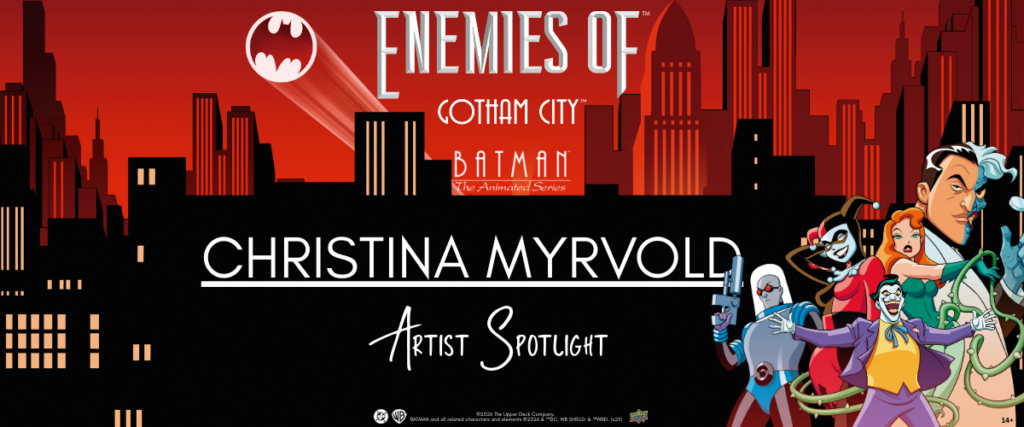
In this Artist Spotlight we are excited to feature the talented Christina Myrvold. Christina Myrvold brings Gotham City™ to life in Enemies of™ Gotham City™. Myrvold was the master 3D sculptor behind the buildings and building toppers in Upper Deck’s newest miniature game, Enemies of™ Gotham City™. Get a behind the scenes look as we discuss Christina Myrvold’s process in sculpting the iconic cityscape in Enemies of™ Gotham City™.

Product depicted for demonstration purposes only and is subject to change without notice. ©2026 The Upper Deck Company.
BATMAN and all related characters and elements ©2026 & ™ DC. WB SHIELD: © & ™ WBEI. (s26) AGES 14+
- How did you go about translating Gotham City into these building sculptures?
First I had to understand what made Gotham such an iconic city; architecturally it blends a variety of styles such as Art Deco and Retrofuturism, but with a Gothic Revival twist, which gives it an intimidating, oppressing and foreboding appearance and presence. Since 3D-printed minis work best with simplified shapes, we leaned into a more streamlined Art Deco and Retrofuturism approach, with less emphasis on the Gothic Revival elements. - Were there any buildings or examples you used as references when sculpting for Enemies of Gotham City?
I was offered a few real-world references by the art team; the Chrysler Building and Empire State Building to name a few, but I also found numerous images of old Art Deco or 50s-style buildings online which helped inspire and inform a lot of the shape language in all of the buildings I designed. - How are you able to balance Gotham City aesthetics with your own design ideas?
I actually happen to be a big fan of both Art Deco and Retrofuturism, so my designs tend to naturally lean toward that direction! I believe it all comes down to understanding what makes a structure feel like it belongs to a specific era or location, and almost putting yourself in the shoes of the architects of said location. Once you grasp the shape language of the style, your own design voice emerges naturally as you problem-solve. - Are there any differences in your workflow when designing a building at this scale compared to a larger-sized project?
Absolutely! For small 3D-printed models, the silhouette is everything. I utilize the principle of “big, medium, small” and make sure that even the smallest parts remain legible when sized down. On larger projects, you can add endless details to sell the design, but with minis, you have to be much more selective about which elements to include. It’s a challenge I personally quite enjoy, and it often pushes my designs in directions I wouldn’t explore at larger scales. - Which techniques did you use to design aspects of the game like the fire/ice/vine pieces?
I started out with designing a rough base in Blender for all the pieces, and eventually moved all of the sculpts to Substance 3D Modeler for further refinement in VR. I find VR sculpting both faster and more creatively flexible than flatscreen workflows, and it’s generally my go-to way of sculpting in 3D. - Which game component that you created is your favorite and why? I’d have to say the plant sculpt, as I spent the most time with it in VR and it just has so much personality. I’d also highlight the Police Building, as it’s the most visually striking and unique out of all the buildings, and it really embodies that classic Art Deco style.
Get first looks of upcoming releases by following Upper Deck on Facebook @upperdeckent, Instagram @upperdeckent, X @upperdeckent, and YouTube @UDvids.
Learn more about Enemies of™ Gotham City™ and the Knight on The Town Expansion by visiting: https://upperdeck.com/enemies-of-gotham/
Make sure to sign up for the Upper Deck Newsletter to have Upper Deck game updates sent straight to your inbox: https://upperdeck.com/sign-up-for-our-email-list/
